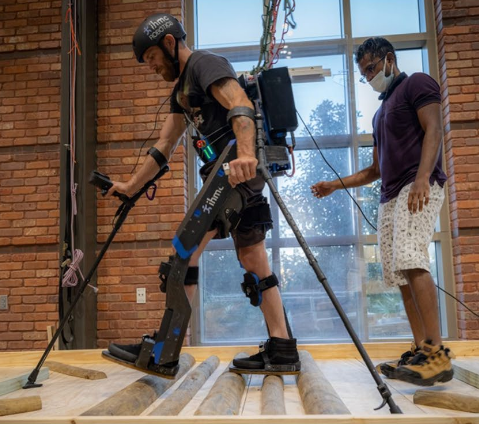
Exokeleton Development
Journal of NeuroEngineering and Rehabilitation (2022)
While working at the Institute for Human and Machine Cognition (IHMC), I contributed to two exoskeleton projects: Quix and Eva.
Quix is an assisstive exoskeleton designed and built by IHMC. In the Quix project, I mostly helped with the evaluation and testing of the finished exoskeleton in preparation for the Cybathlon competition, where we obtained the 4th palce. The details of the mechanical design and the controller are shown in (Peterson et al., 2022). A video of the competition summary is shown below:
Eva is an augmentative exoskeleton designed and built by IHMC. In the Eva project, I largely contributed to the initial bringup of the software-hardware integration of the robot. This entailed setting up the motors and tunning the motor controller communicating over CAN and connecting these to our software controller stack (now, SCS2). The sensors that were integrated were encoders and pressure sensors initially mounted on the soul of the foot. The current version of Eva is available on IHMC’s Eva section.