IEEE-RAS International Conference on Humanoid Robots (Humanoids) 2026 · Under Review

Whole-Body Planning for Humanoids Navigating Confined Spaces via Self-Collision Avoidance References

Anonymous during double-anonymous review.

We present a Whole-Body Planning framework for humanoid locomotion in severely confined spaces without relying on human demonstrations. By combining convex relaxations with differentiable collision constraints, our morphology-aware optimization pipeline synthesizes geometry-aware kinematic guides into dynamically feasible trajectories. These plans enable rapid training of a residual RL policy capable of robust online tracking under sensor noise and dynamic uncertainties.

Key Contributions

01. Geometry-Aware Kinematic References

Extends constrained particle planning to rigid bodies, generating kinematically feasible seeds that discover diverse locomotion styles for self-collision avoidance in confined spaces.

02. Dynamically Consistent Planning

Introduces a morphology-aware optimization pipeline that transcribes complex, collision-free kinematic references into dynamically consistent whole-body trajectories.

03. Closed-Loop Tracking Policy

Deploys a sample-efficient residual policy to robustly track generated whole-body plans in simulation despite sensor noise, modeling uncertainties, and dynamics randomization.

04. Long-Horizon Confined-Space Benchmark

Validates long-horizon plans (12–18s) on the G1 humanoid across three confined environments exceeding NIST standards, successfully operating where baseline planners fail to converge.

Whole-Body Planning (WBP) Pipeline

A three-stage optimization pipeline that progressively refines a plan from environment-aware trajectory optimization to a dynamically feasible, collision-aware whole-body motion, tracked online by a residual policy.

  • Stage 1 — Environment-Aware TO: Uses convex relaxation to plan smooth, reachable end-effector (hands, knees, feet) and torso paths that avoid collisions with surrounding obstacles.
  • Stage 2 — SCA Refinement: Applies primitive proxy geometries and differentiable collision detection to adjust key limb trajectories (e.g., modifying right leg and torso paths to prevent self-contact).
  • Stage 3 — Whole-Body Planning: Generates a dynamically feasible motion plan using the fully articulated WBP Collisions model, enforcing joint limits, torque limits, refined self-collision avoidance, and friction wrench cones. The Visual Mesh provides a clearer view of the resulting motion.

Benchmark Environments

We evaluate our WBP and Control framework on three challenging confined environments:
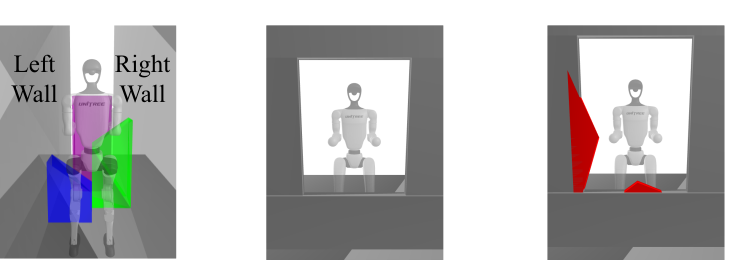
Diagrams of the three benchmark environments: Tilted Stairs, Unobstructed Hole, and Obstructed Hole.

Toggle between the environments, contact sequences, multi-robot view, and domain randomization to visualize the respective motions using the learned controller in the MuJoCo simulator.

Select Environment:
Contact Sequence:
View Mode:
Domain Rand (DR):

Citation

BibTeX entry will be provided upon publication.

@inproceedings{anonymous2026wbp,
  title     = {Whole-Body Planning for Humanoids Navigating Confined
               Spaces via Self-Collision Avoidance References},
  author    = {Anonymous},
  booktitle = {TBD},
  year      = {2026},
  note      = {Under double-anonymous review — citation coming soon}
}